
Table of Contents
- The 2026 Budget: A Catalyst for Market Transformation
- Identifying the Winners and Losers: Sectoral Analysis
- Spotting Institutional Footprints with Online Share Trading Classes
- The New Tax Horizon: Impact on F&O and Capital Gains
- Why Sectoral Rotation Demands a Professional Online Stock Market Class
- The Role of NSE Online Courses in Decoding Policy
- The Omkar Strategy: Custom Blueprints for 2026
- Frequently Asked Questions (FAQs)
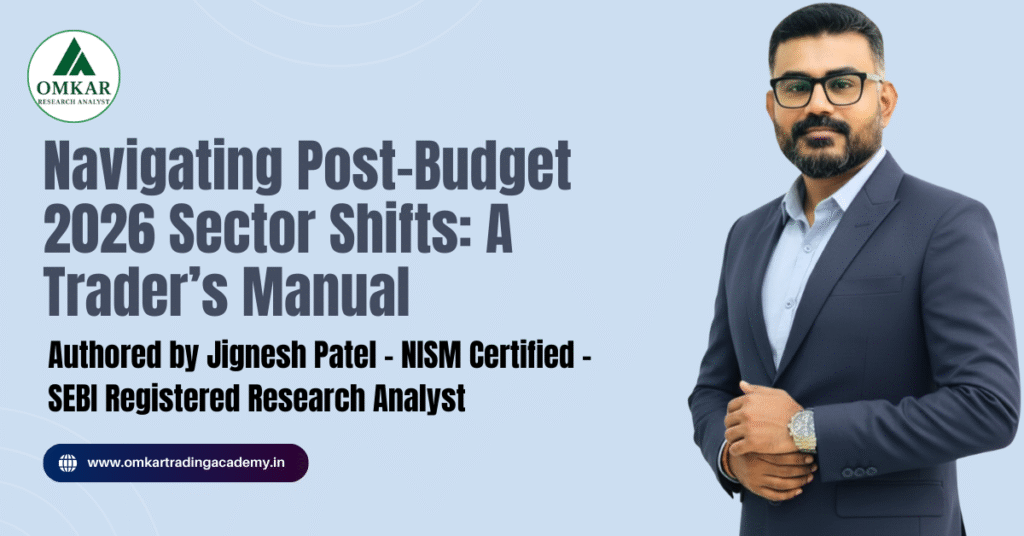
Author: Jignesh Patel
NISM Certified | SEBI Registered Research Analyst
As the dust settles on the Union Budget 2026, the Indian markets have entered a phase of aggressive repricing. In my years as a SEBI Registered Research Analyst, I have seen many budgets, but 2026 stands out for its surgical precision in reallocating capital across the economy. For the retail trader, this isn’t just news—it is a massive shift in the “where” and “when” of profitable trading.
Volatility is simply a transfer of wealth from the unprepared to the educated. If you want to survive this transition, you must move beyond the headlines and look at the raw data.
1. The 2026 Budget: A Catalyst for Market Transformation
The Union Budget is the single most important document for an Indian trader. It sets the theme for the next four quarters. In 2026, we are seeing a clear pivot towards “Green Infrastructure” and “Digital Manufacturing.” For someone looking to learn trading online, understanding this macro-picture is the first step. The market isn’t a single entity; it is a collection of sectors, each reacting differently to government spending.
2. Identifying the Winners and Losers: Sectoral Analysis
The 2026 Budget has drawn a clear line in the sand.
- The Winners: Renewables, Defence, and Semi-conductor manufacturing have seen record allocations. These are no longer just “growth stories”; they are the new market leaders.
- The Losers: Traditional consumption sectors and certain high-import segments are facing margin pressures due to revised duty structures.
In our online stock market course, we teach you how to use relative strength charts to identify which sectors are outperforming the Nifty 50. When the government spends, the institutions follow. If you are not positioned in the winning sectors, you are essentially swimming against the tide.
3. Spotting Institutional Footprints with Online Share Trading Classes
Retail traders often ask, “How do I know what the big players are doing?” The answer lies in Volume Profile and Delivery Data. Online share trading classes at Omkar Academy focus heavily on spotting institutional buying.
After the budget, Big Money doesn’t move in a single minute; they accumulate over days. By mastering professional online stock market training, you learn to spot these “accumulation zones.” Instead of chasing a stock after it has jumped 10%, you learn to enter when the institutions are quietly building their positions.
4. The New Tax Horizon: Impact on F&O and Capital Gains
The 2026 Budget introduced pivotal changes to the tax structure for Derivatives (F&O) and Long-Term Capital Gains (LTCG). For a frequent trader, your “break-even” point has moved.
Analyzing these impacts is a core part of our online share market training. If you are trading without calculating the new STT (Securities Transaction Tax) or the revised slabs, you are working with a blind spot. A professional online trading course doesn’t just teach you where to buy; it teaches you the “net-of-tax” reality of your P&L.
5. Why Sectoral Rotation Demands a Professional Online Stock Market Class
The money in the market is like water—it flows to the path of least resistance. In 2026, we are seeing “Sectoral Rotation” happening at an unprecedented speed. Capital that was locked in overvalued IT stocks is now rushing into Green Energy.
A share market online class is essential here because it teaches you the “Inter-market Analysis.” You learn how commodities, bond yields, and currency fluctuations—all impacted by the budget—dictate which sector will lead the next rally. Without a trading academy online, most traders stay stuck in a “losing” sector, hoping for a recovery that might take years.
6. The Role of NSE Online Courses in Decoding Policy
To truly understand the technicality of the Indian exchanges, one must look at the standards set by nse online courses and bombay stock exchange online courses. These provide the structural knowledge required to navigate the Indian landscape. At Omkar Academy, we integrate these high-level standards into our best online trading classes, ensuring our students are not just traders, but market technicians who understand how policy shifts impact the order book.
7. The Omkar Strategy: Custom Blueprints for 2026
We have updated our three flagship programmes to reflect the post-budget reality:
- Derivatives Trader Programme (10 Weeks): We have added modules on “Tax-Efficient Hedging” and “Budget-Vol Strategies.”
- Master Trader Programme (16 Weeks): Focuses on “Sectoral Strength Scanning” to find the winners of the 2026 fiscal year.
- Mentorship Trader Programme (25 Weeks): 1-on-1 oversight to ensure your portfolio is balanced against the new tax laws and sectoral risks.
If you are looking for the best stock market courses online, you need a curriculum that is live, current, and led by active market participants.
The 2026 Budget has created a new roadmap for wealth. You can either follow the old, outdated maps or learn to read the new ones. By joining an online trading class, you are giving yourself the ultimate hedge: Knowledge. Stop being a spectator to the market’s movements and start being a participant in its profits.
Frequently Asked Questions (FAQs)
1. How quickly should I change my portfolio after the 2026 Budget?
Never rush. The budget impact often plays out over weeks. An online stock market course teaches you to wait for “Confirmation” on the charts before rotating your capital.
2. Is F&O trading still viable with the new tax structures?
Yes, but you must be more selective. In our online share trading classes, we focus on high-probability setups where the potential profit significantly outweighs the increased transaction costs.
3. Which sector is the “Dark Horse” after the 2026 Budget?
While many are looking at Defence, we are seeing massive institutional footprints in “Agri-Tech Infrastructure.” We cover these “unseen” moves in our best online trading classes.
4. Can I learn sectoral rotation through an online trading course?
Absolutely. Sectoral rotation is a measurable phenomenon. Our online share market training uses “Relative Rotation Graphs” (RRG) to show you exactly which sectors are leading and which are lagging.
5. How do I balance NSE online courses with practical training?
NSE online courses provide the theory. Our online stock market training provides the “live” execution. Combining both gives you the best foundation for the Indian market.
6. Do you teach “Budget-Special” strategies in your online trading lessons?
Yes. We have specific “Event Trading” modules in our Master Trader Programme that teach you how to handle the extreme volatility of days like the Budget or RBI Policy announcements.
7. Why is Ahmedabad becoming a centre for best stock market courses online?
Ahmedabad has a rich culture of business. Local traders are now combining that “business sense” with professional online share market classes to create a more disciplined approach to the markets.
8. What is the most important skill to learn trading online in 2026?
Adaptability. The market rules have changed. An online trading class that focuses on “Integrated Analysis” (Fundamental + Technical) is the only way to stay adaptable.
9. Is the 25-week Mentorship Programme suitable for post-budget adjustments?
It is the most suitable. Our Mentorship Trader Programme provides 1-on-1 guidance to help you rebalance your existing portfolio and align it with the 2026 sectoral trends.
10. How can I verify the SEBI credentials of a trading academy online?
Always ask for the SEBI Registration number. At Omkar Trading Academy, our founder Jignesh Patel is a SEBI Registered Research Analyst, ensuring that your education is ethical, regulated, and professional.
The budget has changed the game. It’s time to change your strategy. Book your FREE Demo today.
Related Posts