Trading involves significant risk. Past performance is not indicative of future results.

March 2026

Final Roadmap: Your First 90 Days in the Stock Market

Final Roadmap: Your First 90 Days in the Stock Market

NISM Certified | SEBI Registered Research Analyst Table of Contents Introduction: The Foundation of Financial Freedom Setting Realistic Expectations: The “Learning Curve” Month 1: The Step-by-Step Journey in an Online Stock Market Class Month 2: Building Systems with Online Stock Market Training Month 3: Execution, Psychology, and Risk Management The Transition from Student to Market Graduate Joining the Next Batch at Omkar Trading Academy Frequently Asked Questions (FAQs) 1. Introduction: The Foundation of Financial Freedom Entering the Indian stock market in 2026 is an exhilarating prospect. With the Nifty 50 and Sensex reflecting a dynamic, rapidly evolving domestic economy, the opportunities for wealth creation are vast. However, the initial enthusiasm of a beginner is often quickly extinguished by the brutal reality of institutional algorithms and market volatility. As a SEBI Registered Research Analyst, I have mentored thousands of aspirational traders. I can state with absolute certainty that your success or failure is determined by what you do in your first 90 days. If you use this time to gamble on random tips, you will likely lose your capital. If you use this time to undertake rigorous online stock market training, you will build the foundation for lifelong financial freedom. This roadmap details exactly how to structure your first three months to ensure you survive the learning curve and emerge as a consistent, systematic trader. 2. Setting Realistic Expectations: The “Learning Curve” The greatest disservice the internet has done to retail traders is selling the illusion of overnight riches. If you want to learn trading online, the very first lesson is expectation management. In your first 90 days, your primary goal is not to double your money. Your primary goal is capital preservation and skill acquisition. Trading is a high-performance profession. Just as a medical student does not perform surgery in their first semester, a new trader should not deploy heavy capital in their first month. The “Learning Curve” involves a phase of conscious incompetence—realising how much you do not know. A professional online stock market course guides you through this vulnerable phase safely, ensuring that your inevitable early mistakes are made on paper or with negligible capital, rather than costing you your life savings. 3. Month 1: The Step-by-Step Journey in an Online Stock Market Class Your first 30 days are about dismantling misconceptions and laying a concrete foundation. When you enrol in a premium online stock market class, Month 1 is dedicated to market mechanics. You must move beyond the basic definitions found in standard bombay stock exchange online courses or nse online courses. We focus heavily on market microstructure: understanding the order book, bid-ask spreads, and liquidity. You will learn the difference between cash markets and derivatives. During this phase in our share market online class, we strip away cluttered indicators. You learn to read pure Price Action—how to interpret the psychology behind a candlestick and how volume validates a price move. By the end of Month 1, you will no longer look at a chart as a random collection of lines; you will read it as a narrative of institutional supply and demand. 4. Month 2: Building Systems with Online Stock Market Training Once you understand the language of the market, Month 2 is about building your vocabulary into a system. This is where an advanced online share market course earns its value. In this phase, we transition from theory to strategy. You will learn to use stock screeners to identify high-probability setups, saving you hours of manual analysis. We introduce the concept of “Integrated Analysis”—combining fundamental corporate data (like earnings growth and debt reduction) with technical breakout patterns to find high-growth stocks. More importantly, Month 2 is dedicated to backtesting. Through comprehensive online trading lessons, you will learn to test your newfound strategies against historical market data. You will calculate your win rate and average risk-to-reward ratio. This evidence-based approach transforms you from a speculative gambler into a systematic operator. 5. Month 3: Execution, Psychology, and Risk Management In Month 3, the training wheels come off. This is the most critical phase of your online share market training. You transition from backtesting to live execution. We introduce strict risk management protocols. You will learn the mathematics of position sizing, ensuring you never risk more than 1% of your total capital on a single trade. A high-quality online trading course will teach you to place hard stop-losses and automated bracket orders, removing human hesitation from the equation. This is also where we tackle trading psychology. The pressure of live capital induces fear and greed. Through our interactive online share trading classes, we help you build a trading journal to track your emotional state, ensuring that you execute your proven system flawlessly, regardless of market noise. 6. The Transition from Student to Market Graduate Graduating from the best stock market courses online is not the end of your journey; it is the beginning of your professional career. The transition from student to independent trader requires continuous refinement. As a graduate of our trading academy online, you will no longer seek validation from news channels or social media influencers. You will trust your own analysis. You will view a sudden market crash not with panic, but as a calculated opportunity to deploy capital into undervalued assets or to profit via short-selling and derivative hedges. This independence is the ultimate return on your educational investment. 7. Joining the Next Batch at Omkar Trading Academy To successfully navigate this 90-day roadmap, you need a mentor who operates with SEBI-compliant integrity. At Omkar Trading Academy, we offer the best online trading classes through three elite, custom-tailored programmes: Derivatives Trader Programme (10 Weeks): Designed for traders who have mastered cash equities and want to safely navigate Futures and Options, focusing on Greek management and volatility hedging. Master Trader Programme (16 Weeks): Our flagship online stock trading course. It covers the complete 90-day roadmap and beyond, turning beginners into self-sufficient swing traders and long-term investors. Mentorship Trader Programme (25 Weeks): The pinnacle of

Final Roadmap: Your First 90 Days in the Stock Market Read More »
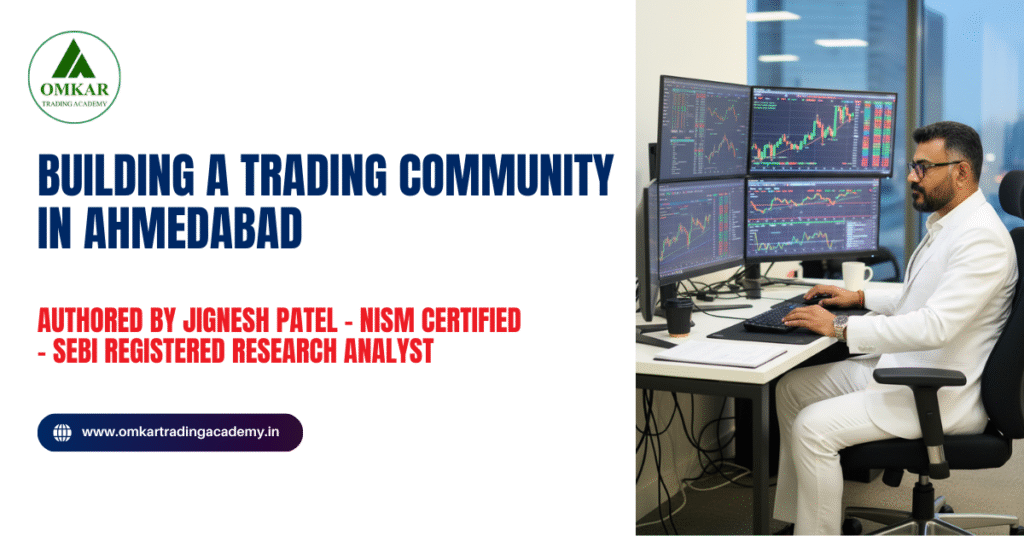
Building a Trading Community in Ahmedabad: The Power of Peer-to-Peer Learning

The Evolution of Trading: From Pit to Pixels

NISM Certified | SEBI Registered Research Analyst Table of Contents Introduction: The Death of the Trading Ring A History of the BSE and NSE for Modern Traders Ahmedabad’s Role in the Indian Financial Revolution The Shift to Learn Trading Online for the Gen-Z Generation Why Stock Exchange Courses Online Are the Future How Omkar Academy Bridges the Old and New Frequently Asked Questions (FAQs) 1. Introduction: The Death of the Trading Ring If you step onto Dalal Street today, the physical energy remains palpable, but the mechanics of wealth creation have fundamentally transformed. There was a time when trading required physical proximity, a booming voice, and aggressive hand signals in a crowded, chaotic trading pit. Today, in 2026, millions of rupees exchange hands in milliseconds, executed by silent algorithms and retail traders clicking a mouse from their living rooms. As a SEBI Registered Research Analyst, I have studied this evolution intimately. The transition from “pit to pixels” has democratised access to the financial markets, but it has also introduced complex technological challenges. To survive this new era, taking an online stock market class is no longer a luxury; it is a vital necessity. Understanding where our markets came from is the first step to mastering where they are going. 2. A History of the BSE and NSE for Modern Traders The story of Indian equity begins under a sprawling banyan tree in Mumbai during the 1850s, where a small group of stockbrokers gathered to trade. This informal congregation eventually formalised into the Bombay Stock Exchange (BSE) in 1875, making it the oldest stock exchange in Asia. For over a century, the BSE operated on the open outcry system—a physical ring where brokers shouted buy and sell orders. However, the defining revolution occurred in 1992 with the incorporation of the National Stock Exchange (NSE). In 1994, the NSE launched electronic screen-based trading, completely disrupting the BSE’s monopoly. This shift brought transparency, speed, and nationwide access, forcing the BSE to modernise and adopt its own electronic system, BOLT. Today, the sheer volume handled by these exchanges requires a deep understanding of digital liquidity. Foundational bombay stock exchange online courses and nse online courses are excellent for learning this history, but applying this knowledge to a live screen requires the tactical edge of a professional online trading course. 3. Ahmedabad’s Role in the Indian Financial Revolution Gujarat has always been the commercial beating heart of India, and Ahmedabad is its epicentre. Historically, the Ahmedabad Stock Exchange (ASE), founded in 1894, was a massive hub for textile and manufacturing shares. The local “Vepari” (business) community inherently understood the nuances of supply, demand, and risk. As physical exchanges phased out, Ahmedabad’s traders adapted rapidly to the digital revolution. However, the traditional “Sauda” (verbal agreement) mentality had to be replaced by strict risk management and chart analysis. Today, the modern Gujarati entrepreneur does not rely on local tips; they rely on data. By participating in an online share market course, Ahmedabad’s aspirational traders are successfully merging their generational business acumen with cutting-edge quantitative strategies. 4. The Shift to Learn Trading Online for the Gen-Z Generation We are witnessing a massive demographic shift. The Gen-Z generation, born as digital natives, has entered the workforce and the financial markets. Unlike previous generations who relied on mutual funds or bank advisors, Gen-Z prefers direct control over their capital. They do not want to commute to physical seminar halls to listen to outdated lectures. They want to learn trading online through interactive, data-driven platforms. A high-quality online stock market training programme appeals to this demographic because it offers flexibility, allowing them to study market microstructure and backtest strategies directly from their laptops. This generation understands that wealth creation requires digital literacy, making the best online trading classes highly sought after. 5. Why Stock Exchange Courses Online Are the Future The traditional methods of learning the stock market—reading static books or attending weekend seminars—are woefully inadequate for the high-frequency markets of 2026. The market is a live, breathing entity. Stock exchange courses online represent the future of financial education because they provide a dynamic learning environment. When you join a structured share market online class, you are not just looking at historical charts; you are analysing live order flow. You learn how to use automated stock screeners, how to hedge with options, and how to execute algorithmic trades. Furthermore, comprehensive online share trading classes provide the crucial element of community and continuous mentorship. You are connected to a network of like-minded individuals and guided by a SEBI Registered professional who can correct your mistakes in real-time. 6. How Omkar Academy Bridges the Old and New At Omkar Trading Academy, we honour the traditional wisdom of capital preservation while equipping you with the technological arsenal of a modern trader. As a premier trading academy online, we have developed three custom blueprints designed to turn aspirational beginners into systematic professionals: Derivatives Trader Programme (10 Weeks): The digital era has made Options trading highly accessible but incredibly risky. This online trading class teaches you how to mathematically manage risk, master Option Greeks, and deploy advanced hedging strategies. Master Trader Programme (16 Weeks): Our definitive online share market training experience. We teach you how to read institutional footprints on digital charts, blending fundamental analysis with precise technical execution to identify the next multibagger. Mentorship Trader Programme (25 Weeks): The pinnacle of the best stock market courses online. This provides intensive 1-on-1 coaching, real-time portfolio oversight, and the psychological conditioning necessary to survive and thrive in a screen-based trading environment. If you are looking for the best trading courses online, you must choose a curriculum that bridges traditional business logic with modern digital execution. The evolution from the bustling trading pits of the BSE to the silent, pixelated screens of modern broker terminals is a testament to human innovation. While the tools have changed drastically, the core principles of risk and reward remain the same. To capitalise on this digital revolution, you must upgrade your

The Evolution of Trading: From Pit to Pixels Read More »

The Evolution of Trading: From Pit to Pixels

Building a Trading Community in Ahmedabad: The Power of Peer-to-Peer Learning

NISM Certified | SEBI Registered Research Analyst Table of Contents Introduction: The Solitude of the Modern Trader The Importance of Peer-to-Peer Learning in Trading Networking Opportunities in the Best Online Trading Classes How Omkar Trading Academy Creates a “Mastermind” Group The Role of the Lifetime Support Group for Online Share Market Course Students Growing Together: Our 3 Elite Trading Programmes Frequently Asked Questions (FAQs) 1. Introduction: The Solitude of the Modern Trader In 2026, the image of the stock market has been heavily digitised. We trade from our laptops, analyse charts on our smartphones, and execute orders in isolation. However, as a SEBI Registered Research Analyst, I have observed that this digital isolation is one of the primary reasons many retail traders fail. Ahmedabad is a city built on the foundation of community and commerce. Historically, the local “Vepari” (business) culture thrived on verbal exchanges, shared market intelligence, and collective wisdom at the local markets. Today, that physical gathering has disappeared for the retail investor, leaving them alone with their screens and their psychological biases. If you truly want to learn trading online and build a sustainable financial career, you cannot do it in a vacuum. A comprehensive online stock market course must do more than just deliver recorded lectures; it must rebuild that sense of community. This guide explores why joining a network of educated, like-minded traders is the ultimate catalyst for your financial success. 2. The Importance of Peer-to-Peer Learning in Trading When you trade alone, your mistakes happen in an echo chamber. If you misread a volume breakout or execute a flawed options spread, there is no one to point out the technical error before you risk your capital. Peer-to-peer learning actively dismantles this echo chamber. When you enrol in a premium online stock market class, you are placed alongside individuals who are analysing the exact same charts and learning the exact same risk management rules. If you miss a critical resistance level on the Nifty 50, a peer will likely spot it. Furthermore, trading psychology is incredibly taxing. Experiencing a streak of losses can severely dent your confidence. Having a community of peers who understand the emotional toll of the markets provides invaluable psychological support, preventing you from making impulsive “revenge trades.” This shared resilience is a hallmark of the best trading courses online. 3. Networking Opportunities in the Best Online Trading Classes An online share market training programme is a melting pot of professionals. In our academy, you will find IT engineers, doctors, traditional business owners, and university students all working towards the same goal: financial independence. The networking opportunities here are immense. An IT professional might share a custom algorithmic screener they built for TradingView, whilst a traditional business owner might offer profound insights into the macroeconomic supply chains affecting specific mid-cap stocks. When you participate in an interactive share market online class, you are not just learning from the instructor; you are absorbing the collective professional experience of the entire cohort. This synergy transforms standard online trading lessons into a dynamic, real-world financial think tank. 4. How Omkar Trading Academy Creates a “Mastermind” Group The concept of a “Mastermind” group was popularised by Napoleon Hill, who stated that when two or more minds come together in a spirit of harmony, they create a third, intangible force—the mastermind. We have embedded this philosophy directly into our curriculum. We do not just offer stock exchange courses online; we build ecosystems. Within our advanced online share trading classes, students are grouped into dedicated cohorts. These mastermind groups hold weekly digital meetups to discuss upcoming market events, review the previous week’s trades, and dissect complex setups. By debating the merits of a specific fundamental breakout or challenging each other’s technical analysis, our students sharpen their analytical edge far beyond what basic nse online courses or bombay stock exchange online courses can provide. 5. The Role of the Lifetime Support Group for Online Share Market Course Students The financial markets are not static. The strategies that worked brilliantly in the bull run of 2024 required massive adjustments to survive the volatility of early 2026. If your online stock market training ends the day you receive your certificate, you are being set up for long-term failure. This is why Omkar Trading Academy offers a Lifetime Support Group. When you graduate from our online share market course, you do not leave the community; you graduate into the alumni network. As a SEBI Registered Analyst, I continuously update this group with live market commentary, shifts in macroeconomic data, and structural changes to our trading strategies. This ensures that years after you complete your online trading class, you remain actively aligned with the current market reality. 6. Growing Together: Our 3 Elite Trading Programmes To facilitate this community-driven growth, we have structured our education into three distinct, highly interactive pathways. Whether you are seeking the best online trading classes for beginners or advanced mentorship, our SEBI-compliant programmes are designed to integrate you into our mastermind ecosystem: Derivatives Trader Programme (10 Weeks): Options trading requires absolute precision. In this cohort, you will collaborate with peers to analyse Option Greeks, share complex hedging strategies, and navigate high-volatility events together. Master Trader Programme (16 Weeks): Our flagship online stock trading course. Here, the community focuses on identifying high-probability equity swing trades, sharing custom screeners, and mastering Integrated Analysis (Fundamental + Technical) as a collective. Mentorship Trader Programme (25 Weeks): The pinnacle of our trading academy online. Not only do you receive intensive 1-on-1 coaching, but you also become a senior member of our lifetime support network, actively guiding newer students while perfecting your own institutional edge. If you are looking for the best stock market courses online, prioritise those that offer a thriving, post-education community. Trading does not have to be a solitary journey. By joining a structured community of educated, disciplined, and ambitious individuals, you accelerate your learning curve, protect your psychological capital, and uncover market opportunities you would have otherwise missed. Do

Building a Trading Community in Ahmedabad: The Power of Peer-to-Peer Learning Read More »

Trading During Results Season: High Reward, High Risk

Trading During Results Season: High Reward, High Risk

NISM Certified | SEBI Registered Research Analyst Table of Contents Introduction: The Volatility of Earnings Season Analysing Quarterly Results Like a Pro How to Trade the “Post-Result” Gap Lessons from Online Share Trading Classes on Earnings Volatility Why Bombay Stock Exchange Online Courses Focus on Corporate Governance Risk-Mitigation Strategies for “Event Days” The Omkar Academy Advantage: Custom Programmes for Traders Frequently Asked Questions (FAQs) 1. Introduction: The Volatility of Earnings Season Four times a year, the Indian stock market enters a phase of extreme unpredictability: the quarterly results season. For a few short weeks, the fundamentals of India Inc. are laid bare. Corporate giants announce their profits, adjust their forward guidance, and the market reacts with sheer volatility. For the uneducated retail speculator, trading during results season is nothing more than a coin toss—a gamble that frequently results in decimated trading capital. However, for the trained professional, this period offers unparalleled opportunities. When institutional money aggressively repositions itself based on earnings data, massive, profitable trends are born. If you truly want to learn trading online and capture these high-reward moves safely, you must abandon guesswork and embrace a structured online stock market class. 2. Analysing Quarterly Results Like a Pro The biggest mistake amateur traders make is looking exclusively at the “Net Profit” headline on a news channel. If a company announces a 20% jump in profit, retail traders often blindly buy the stock the next morning, only to watch the price plummet. Why does this happen? Because the market is forward-looking. Institutions do not trade the past quarter; they trade the management’s commentary for the next quarter. When you enrol in a premium online stock market course, you learn to read an earnings report like an institutional analyst. We teach you to look at: EBITDA Margins: Is the company actually making money on its core operations, or was the profit artificially inflated by a one-time asset sale? Year-on-Year (YoY) vs. Quarter-on-Quarter (QoQ): Understanding seasonal business cycles. Management Guidance: If a company posts great numbers but warns of upcoming supply chain issues, the “Smart Money” will sell. By mastering these metrics through a dedicated online share market training programme, you stop getting trapped by misleading headlines. 3. How to Trade the “Post-Result” Gap Earnings announcements typically occur after market hours. Consequently, the stock will often open the next morning with a massive “Gap Up” or “Gap Down.” Trading these gaps is highly perilous. If a stock gaps up 8% on great results, buying at the open often means buying at the absolute top of the day, right as early investors begin booking profits. In our online share trading classes, we teach specific gap-trading mechanics. We instruct our students to wait for the first 15 to 30 minutes to let the algorithmic “noise” settle. If a stock gaps down on bad news but immediately starts forming bullish price action with heavy volume, it signifies that institutional buyers feel the bad news was already priced in and are now accumulating shares at a discount. Learning to read this real-time price action is a core module in any of the best online trading classes. 4. Lessons from Online Share Trading Classes on Earnings Volatility If you trade Futures and Options (F&O), results season is a minefield of “Implied Volatility” (IV). Before a major earnings announcement, uncertainty is high, causing option premiums to skyrocket. Many novice traders buy Call or Put options the day before results, hoping for a big directional move. The next day, even if the stock moves in their predicted direction, they lose money. This phenomenon is known as the “IV Crush.” Once the news is out, the uncertainty vanishes, and the option premiums deflate instantly. To survive in the derivatives segment, you need rigorous online stock market training. A professional online trading course will teach you to stop buying naked options before events and instead use volatility-neutral strategies like Iron Condors or Calendar Spreads to actually profit from the IV Crush. 5. Why Bombay Stock Exchange Online Courses Focus on Corporate Governance Results season occasionally uncovers unpleasant truths. We have all seen instances where a company delays its earnings report or an independent auditor resigns abruptly. These are severe red flags indicating poor corporate governance. Foundational bombay stock exchange online courses and nse online courses place heavy emphasis on the regulatory frameworks and disclosure norms companies must follow. While these stock exchange courses online provide the legal theory, our academy teaches you the practical application: If an auditor qualifies their report, you exit the stock immediately, regardless of what the technical chart looks like. Protecting your capital from toxic management is the most valuable lesson you will ever learn. 6. Risk-Mitigation Strategies for “Event Days” Results days are “Event Days.” The standard technical support and resistance levels can be violently broken during these sessions. Therefore, any reputable share market online class must instil strict risk-mitigation protocols. Our primary rule during results season is simple: Halve your position size. If you normally risk 2% of your capital on a swing trade, you reduce it to 1%. Furthermore, we teach the use of hedging. If you are holding a long-term portfolio of IT stocks and TCS is about to announce its results, our online trading lessons will guide you on how to buy a protective Put option on the Nifty IT index. This ensures that a negative surprise does not wipe out months of accumulated wealth. 7. The Omkar Academy Advantage: Custom Programmes for Traders Navigating the treacherous waters of earnings season requires more than a few YouTube videos; it demands structured, SEBI-compliant education. At Omkar Trading Academy, we offer the best trading courses online, specifically tailored to handle high-risk market events: Derivatives Trader Programme (10 Weeks): Master the mechanics of Implied Volatility. Learn exactly how to structure options spreads to profit from the post-earnings “IV Crush” without taking directional risks. Master Trader Programme (16 Weeks): The definitive online share market course. We teach you how to integrate fundamental earnings analysis

Trading During Results Season: High Reward, High Risk Read More »

Decoding Multi-Timeframe Analysis: The Secret to Precision Trading

Decoding Multi-Timeframe Analysis: The Secret to Precision Trading

NISM Certified | SEBI Registered Research Analyst Table of Contents Introduction: The Danger of “Tunnel Vision” in Trading Matching the Weekly Trend with Daily Entries A Key Lesson in Any Online Stock Trading Course Spotting Trend Reversals Before They Happen Why Online Share Market Training Must Cover Timeframe Alignment Improving Your Strike Rate by 40% The Omkar Academy Edge: Custom Trading Programmes Frequently Asked Questions (FAQs) 1. Introduction: The Danger of “Tunnel Vision” in Trading As we navigate the highly algorithmic and rapid Indian stock market of 2026, a recurring problem plagues retail traders: tunnel vision. I frequently consult with individuals who are executing trades based purely on a 15-minute or daily chart, completely oblivious to the fact that the broader weekly market is moving aggressively in the opposite direction. As a SEBI Registered Research Analyst, I have always stressed that no single timeframe tells the complete story of a stock. To trade with institutional precision, you must step back and view the market through multiple lenses. This concept, known as Multi-Timeframe Analysis (MTFA), is the cornerstone of professional execution. If you genuinely want to learn trading online and stop getting trapped in false breakouts, mastering MTFA is not optional; it is mandatory. 2. Matching the Weekly Trend with Daily Entries The fundamental rule of Multi-Timeframe Analysis is simple: use a higher timeframe to determine the overall trend (the macro environment) and a lower timeframe to pinpoint your entry (the micro execution). For a swing trader, the most powerful combination is the Weekly-Daily setup. The Weekly Chart: This tells you what the “Smart Money” is doing. If a stock is making higher highs and higher lows on the weekly chart, the institutional bias is bullish. You should only be looking for buying opportunities. The Daily Chart: This is where you pull the trigger. You wait for the daily chart to pull back to a logical support level or break out of a consolidation pattern in the direction of the weekly trend. By executing this top-down approach, you are effectively swimming with the tide rather than against it. A premium online stock market class will rigorously train you to ensure your daily entries are perfectly synchronised with the weekly momentum. 3. A Key Lesson in Any Online Stock Trading Course Beginners often mistakenly believe that the secret to profitability lies in finding the perfect technical indicator. They bounce from RSI to MACD, searching for a holy grail. However, the most robust best trading courses online teach that market structure across timeframes is infinitely more reliable than any lagging indicator. When you enrol in a structured online stock trading course, the first paradigm shift you experience is visualising the market as a set of nested cycles. An hourly downtrend is often just a healthy pullback within a daily uptrend. Without an online share market course to teach you this hierarchy, you will panic and sell your positions precisely at the moment the higher timeframe is preparing for its next leg up. 4. Spotting Trend Reversals Before They Happen One of the greatest advantages of Multi-Timeframe Analysis is the ability to anticipate trend reversals before they become obvious to the broader retail public. Trends do not reverse instantly; they degrade from the bottom up. A reversal on the monthly chart begins as a shift in character on the weekly chart, which originally started as a breakdown on the daily chart. [Image demonstrating a trend reversal signal starting with a lower high on a daily timeframe before breaking the primary trend on the weekly timeframe] If you are holding a long position based on a weekly trend, monitoring the daily chart allows you to spot early warning signs—such as a sudden massive volume spike on a bearish daily candle. This early detection system is a core module in our online share trading classes. It gives you the necessary time to tighten your stop-losses or lock in profits before the higher timeframe officially breaks down. 5. Why Online Share Market Training Must Cover Timeframe Alignment Many foundational bombay stock exchange online courses and nse online courses focus purely on exchange mechanics and basic chart patterns. However, a “Bull Flag” pattern on a 15-minute chart has an incredibly low probability of success if the daily chart is hitting major overhead resistance. This is why holistic online share market training must cover timeframe alignment. In our share market online class, we introduce the concept of “Confluence.” We teach our students to only deploy capital when the weekly, daily, and hourly charts are all pointing in the same direction. This strict alignment filters out market noise and protects your capital from being chopped up in highly volatile, directionless periods. 6. Improving Your Strike Rate by 40% In the financial markets, profitability is a function of your win rate (strike rate) and your risk-to-reward ratio. By simply adding Multi-Timeframe Analysis to your existing strategy, it is statistically common to see your strike rate improve by up to 40%. Why? Because you are systematically eliminating low-probability trades. When you take an online trading class that enforces MTFA, you stop buying stocks that are technically “oversold” on a daily chart but are in a freefall on the weekly chart. You stop catching falling knives. The best stock market courses online transform you from a reactive gambler into a highly selective sniper, taking only the trades where the macro and micro probabilities are heavily stacked in your favour. 7. The Omkar Academy Edge: Custom Trading Programmes To master the nuances of timeframe alignment, you require structured mentorship from active market professionals. As a leading trading academy online, Omkar Trading Academy has integrated Multi-Timeframe Analysis into three elite, SEBI-compliant programmes tailored to your specific goals: Derivatives Trader Programme (10 Weeks): Focuses on aligning daily options flow with weekly index trends. Perfect for traders seeking to leverage F&O safely through synchronised hedging. Master Trader Programme (16 Weeks): The definitive online stock market training for equity traders. Learn to scan for weekly breakouts and

Decoding Multi-Timeframe Analysis: The Secret to Precision Trading Read More »

The Importance of Backtesting: Proving Your Edge in the Market

The Importance of Backtesting: Proving Your Edge in the Market

NISM Certified | SEBI Registered Research Analyst Table of Contents Introduction: The Illusion of Intuition How to Verify if a Strategy Works Before Risking Capital Turning a Trading “Idea” into a Mechanical “System” Tools for Backtesting Taught in the Best Online Trading Classes The Role of Statistics in an Online Share Market Course Why We Emphasise “Evidence-Based Trading” at Omkar Academy The Omkar Pathway: Custom Programmes for Systematic Trading Frequently Asked Questions (FAQs) 1. Introduction: The Illusion of Intuition In the modern Indian stock market, one of the most dangerous phrases a retail trader can utter is, “I have a feeling this stock will go up.” Intuition might serve you well in traditional business or daily life, but in the highly algorithmic financial markets of 2026, relying on your “gut” is a mathematical blueprint for disaster. As a SEBI Registered Research Analyst, I have audited the portfolios of countless struggling traders. The common denominator among those who consistently lose money is a complete lack of historical verification. They execute trades based on tips, news, or untested chart patterns. To transition from a gambler to a professional, you must demand proof that your strategy works. This proof is acquired through rigorous backtesting. If you want to genuinely learn trading online, mastering the art of backtesting is your first step towards building an unshakeable market edge. 2. How to Verify if a Strategy Works Before Risking Capital Backtesting is the process of applying a specific set of trading rules to historical market data to see how those rules would have performed in the past. The logic is straightforward: if a strategy failed to make money over the last five years, it is highly unlikely to miraculously start making money tomorrow. Many beginners treat their live trading accounts as testing grounds. This is an incredibly expensive mistake. When you enrol in a premium online stock market class, you learn that your capital is your inventory. You do not risk inventory on an unproven concept. By historically verifying your strategy over hundreds of past trades, you gain the psychological conviction required to execute that strategy flawlessly in the live market, even during periods of inevitable drawdowns. 3. Turning a Trading “Idea” into a Mechanical “System” An “idea” is vague: “I will buy when the moving averages cross and sell when it looks weak.” A “system” is precise: “I will buy 100 shares of a Nifty 50 stock when the 9 EMA crosses above the 21 EMA on a 15-minute timeframe, placing a hard stop-loss at 1% below the entry candle, and exiting automatically at a 1:2 risk-to-reward ratio.” You cannot backtest an idea, but you can backtest a system. In our online share market training, we spend significant time teaching students how to quantify their rules. A robust system must have zero ambiguity regarding entry triggers, stop-loss placement, position sizing, and profit targets. Transforming subjective ideas into objective, testable systems is the hallmark of professional online trading lessons. 4. Tools for Backtesting Taught in the Best Online Trading Classes To conduct a professional backtest, you require the right technology. Manual backtesting—scrolling back through charts and writing down hypothetical trades in a notebook—is a great starting point, but it is prone to human error and hindsight bias. The best trading courses online introduce you to advanced, automated tools. For instance, the ‘Bar Replay’ feature on charting platforms like TradingView allows you to simulate historical data candle-by-candle, masking future price action so you can test your psychological reactions as well as your strategy’s technical viability. Furthermore, we teach our students how to use Excel and algorithmic screeners like Chartink. A comprehensive online stock trading course equips you with the spreadsheet templates necessary to record your historical trades, ensuring you capture vital data points effortlessly. 5. The Role of Statistics in an Online Share Market Course A backtest is only as valuable as the statistics it generates. When you review the syllabus of high-quality stock exchange courses online, you will find entire modules dedicated to trade expectancy. A professional trader analyses three core metrics: Win Rate: The percentage of trades that are profitable. Risk-to-Reward Ratio (R:R): How much you win on average compared to how much you lose. Maximum Drawdown: The largest peak-to-trough drop in your portfolio value during the testing period. You might be surprised to learn that a strategy with a 40% win rate can be highly profitable if the R:R is 1:3. Conversely, a strategy with an 80% win rate can destroy your account if your average loss is five times larger than your average win. Understanding this statistical interplay is a core component of our online share trading classes. 6. Why We Emphasise “Evidence-Based Trading” at Omkar Academy “Evidence-Based Trading” means that every single rule in your trading plan is backed by hard data. We do not teach our students to trust a pattern just because it looks good in a textbook; we teach them to verify it across a decade of Nifty data. This empirical approach removes the emotional turmoil from trading. When you face a streak of five losing trades, an uneducated trader panics and changes their strategy. An evidence-based trader, who has learned through a rigorous online trading course, knows that a five-trade losing streak is statistically normal within their historically proven system, allowing them to continue executing their plan without fear. 7. The Omkar Pathway: Custom Programmes for Systematic Trading Whether you are exploring foundational bombay stock exchange online courses or seeking advanced execution strategies, Omkar Trading Academy provides a structured path to mastery. As a premier trading academy online, we weave backtesting into all our SEBI-compliant programmes: Derivatives Trader Programme (10 Weeks): Options trading requires absolute mathematical precision. We teach you how to backtest complex Option Greeks and spread strategies using specialised derivative software. Master Trader Programme (16 Weeks): The ultimate online stock market course for equity traders. Learn to build, code, and test mechanical swing and intraday trading systems, translating raw data into consistent profits. Mentorship

The Importance of Backtesting: Proving Your Edge in the Market Read More »

Understanding Liquidity and Slippage: The Hidden Costs of Trading

Understanding Liquidity and Slippage: The Hidden Costs of Trading

NISM Certified | SEBI Registered Research Analyst Table of Contents Introduction: The Invisible Barrier to Profits Why “Paper Trading” Isn’t the Same as “Real Trading” Calculating the “Hidden Cost” of Trading: Understanding Slippage Why Liquidity Matters for the Ahmedabad-Based High-Net-Worth Trader How a Share Market Online Class Teaches You to Find Deep Markets Lessons from an Online Trading Course on Flawless Execution The Omkar Academy Advantage: Master Market Execution Frequently Asked Questions (FAQs) 1. Introduction: The Invisible Barrier to Profits Many aspirational traders focus entirely on charting and technical indicators, believing that spotting the right entry point is the only key to wealth. However, as a SEBI Registered Research Analyst, I constantly remind my students that identifying a trade is only 50% of the equation; the other 50% is execution. In the live markets of 2026, two silent forces dictate your actual profitability: Liquidity and Slippage. If you are evaluating an online stock market course, it is vital that the curriculum goes beyond theoretical patterns and addresses the mechanics of the order book. Buying a stock on a screen is easy, but getting your order filled at the exact price you want is a skill. This guide will decode these hidden costs and explain why mastering market depth is the true hallmark of a professional trader. 2. Why “Paper Trading” Isn’t the Same as “Real Trading” Beginners are frequently advised to start with “paper trading”—using simulated money to practice their strategies. While this is an excellent way to learn the basic mechanics of a charting platform, it creates a dangerous illusion of competence. In a paper trading simulator, your orders are filled immediately at the Last Traded Price (LTP). If you press “Buy” at ₹150.00, you receive the shares at exactly ₹150.00. The simulator does not care if there is a seller available at that price. In the real world, the market operates on an auction system. For you to buy 1,000 shares at ₹150.00, there must be a seller willing to part with 1,000 shares at ₹150.00. If there are only 200 shares available at that price, your market order will start consuming shares at ₹150.10, ₹150.20, and so on until your order is completely filled. This discrepancy between the simulator and the live exchange is precisely why transitioning to real capital requires the structured guidance of a premier online stock market class. 3. Calculating the “Hidden Cost” of Trading: Understanding Slippage The difference between the price you expect to pay and the price you actually pay is called “Slippage.” Slippage is the hidden tax on uneducated retail traders. Imagine you spot a breakout on a mid-cap stock and place a market order to buy 5,000 shares at ₹200. Because the stock is illiquid (meaning there are few active buyers and sellers), the bid-ask spread is wide. The best available seller is actually asking for ₹202. Your order executes at an average price of ₹201.50. You have just paid a 0.75% premium simply to enter the trade. In our online share market training, we teach you how to calculate this hidden cost. If your profit target is only 2%, losing nearly 1% to slippage destroys your risk-to-reward ratio. This is why learning to mitigate slippage is a mandatory module in the best trading courses online. 4. Why Liquidity Matters for the Ahmedabad-Based High-Net-Worth Trader Ahmedabad is home to a massive community of High-Net-Worth Individuals (HNIs) and successful entrepreneurs. When these “Veparis” enter the market, they are not trading 10 or 20 shares; they are deploying capital in lakhs and crores. For an HNI, liquidity is the most critical metric. Liquidity refers to how quickly and easily an asset can be bought or sold without affecting its price. If an Ahmedabad-based trader attempts to deploy ₹50 Lakhs into an illiquid small-cap stock via a market order, their own buying pressure will artificially drive the stock price up against them. When these traders enrol in our online share trading classes, we teach them the art of institutional execution. We focus on trading only the top 100 highly liquid stocks and deploying capital systematically rather than all at once. 5. How a Share Market Online Class Teaches You to Find Deep Markets A “deep” market is one with a massive volume of pending orders at every price level, such as the Nifty 50 constituents or highly active liquid options. When you participate in a comprehensive share market online class, you learn how to use volume scanners to identify these deep markets. We teach our students to avoid stocks where the average daily volume is below a specific institutional threshold. By participating in stock exchange courses online, you understand how to read the “Market Depth” window on your broker’s terminal, ensuring that the bid-ask spread is tight (e.g., a 5-paisa difference rather than a 50-paisa difference) before you ever risk your capital. 6. Lessons from an Online Trading Course on Flawless Execution How do you defeat slippage? The primary weapon is the Limit Order. Unlike a market order, which guarantees execution but not price, a limit order guarantees price but not execution. In our online trading lessons, we instil a strict rule: never use market orders on illiquid instruments. We teach you how to place limit orders at strategic supply and demand zones, forcing the market to come to your price. Furthermore, advanced bombay stock exchange online courses and modern nse online courses explain the mechanics of “Iceberg Orders”—a technique used to slice large orders into smaller, hidden chunks to prevent alarming the market. We take these concepts and show you exactly how to execute them on your retail broker terminals. 7. The Omkar Academy Advantage: Master Market Execution To protect your capital from the hidden costs of slippage and illiquidity, you require professional, SEBI-compliant mentorship. At Omkar Trading Academy, we have developed three bespoke programmes that emphasise flawless execution: Derivatives Trader Programme (10 Weeks): Options trading is highly susceptible to slippage due to wide bid-ask spreads on OTM (Out of The

Understanding Liquidity and Slippage: The Hidden Costs of Trading Read More »

Why Self-Learning via YouTube is Costing You Lakhs in the Stock Market

Why Self-Learning via YouTube is Costing You Lakhs in the Stock Market

NISM Certified | SEBI Registered Research Analyst Table of Contents Introduction: The Illusion of “Free” Knowledge The Lack of Structure in Free Online Stock Market Training The Danger of “Recency Bias” in Free Content Why a Structured Online Trading Course Provides Accountability The Unmatched Value of a Mentor in Your Online Share Market Classes Investment in Education vs. Tuition Paid to the Market The Omkar Advantage: Custom Programmes for Serious Traders Frequently Asked Questions (FAQs) 1. Introduction: The Illusion of “Free” Knowledge We live in an era of unprecedented information abundance. If you want to learn trading online today, a simple YouTube search will yield millions of videos promising secret strategies and overnight wealth. For the aspirational trader, this wealth of free content seems like a blessing. Why pay for an online stock market class when everything is available for free? As a SEBI Registered Research Analyst, I have mentored hundreds of traders who started with this exact mindset. Almost all of them came to me only after they had decimated their trading capital. The harsh reality of the 2026 financial markets is that “free” advice is often the most expensive advice you will ever take. In this guide, I will break down exactly why relying on disjointed videos is costing you lakhs, and why structured education is the only sustainable path to financial independence. 2. The Lack of Structure in Free Online Stock Market Training The primary flaw with YouTube learning is the complete absence of a curriculum. Professional trading is a sequential discipline. You cannot understand Options Greeks without first mastering market microstructure, and you cannot master market microstructure without understanding basic price action. When a beginner relies on free online stock market training, they suffer from “strategy hopping.” On Monday, they watch a video about the MACD indicator. On Tuesday, the algorithm feeds them a video claiming MACD is useless and they must trade breakouts. On Wednesday, they are told to abandon equities entirely and sell Bank Nifty options. This chaotic consumption of information leads to analysis paralysis. A professional online share market course provides a linear, structured pathway. It strips away the noise and builds your foundation block by block, ensuring you master risk management before you ever press the “Buy” button. 3. The Danger of “Recency Bias” in Free Content Content creators on free platforms are incentivised by views and engagement, not by your long-term profitability. This creates a severe “Recency Bias.” If mid-cap IT stocks have rallied for the last three weeks, every new video will be about “How to find Mid-Cap Breakouts.” The creator is teaching you a strategy tailored for a very specific, fleeting market condition. When the market cycle inevitably shifts from a bull phase to a sideways consolidation or a bear market, the strategies you learned for free will fail spectacularly. In contrast, taking the best online trading classes exposes you to education that covers all market cycles. A comprehensive share market online class teaches you how to identify whether the market is trending or ranging, and which specific strategies to deploy for each environment. You learn to trade the market in front of you, not the market from last month’s viral video. 4. Why a Structured Online Trading Course Provides Accountability Human psychology is wired to take the path of least resistance. When you consume free content, you have no financial or emotional skin in the game. You might watch a brilliant video on maintaining a trading journal, but because you did not pay for the advice, you lack the urgency to implement it. When you enrol in a premium online trading course, you make a psychological commitment to your own success. The best trading courses online enforce strict rules. You are given assignments, your risk management parameters are checked, and you are held accountable to a trading plan. This level of discipline simply cannot be replicated by hitting “Subscribe” on a video channel. 5. The Unmatched Value of a Mentor in Your Online Share Market Classes A recorded video cannot look at your portfolio and tell you why you are losing money. It cannot identify that your position sizing is too large or that you suffer from revenge trading after a loss. Trading is highly individualised. Your risk appetite, capital size, and psychological triggers are unique. This is where the value of a mentor in your online share market classes becomes immeasurable. A SEBI Registered mentor provides real-time feedback. During live online trading lessons, you have the opportunity to ask specific questions about live market scenarios. You learn not just what a pattern looks like in a textbook, but how it behaves dynamically at 9:15 AM on a volatile Monday morning. 6. Investment in Education vs. Tuition Paid to the Market One of the greatest paradoxes in the trading community is the reluctance to pay for education combined with the willingness to lose massive amounts of capital. A retail trader will refuse to spend a fraction of their capital on the best stock market courses online, viewing it as an “expense.” Yet, that same trader will blindly buy out-of-the-money options based on a free tip and lose ₹50,000 in a single afternoon. This is what professionals call “paying tuition to the market.” The market is an unforgiving teacher. It will charge you lakhs of rupees in losses to teach you a lesson about risk management that a structured online stock trading course would have taught you safely. Investing in an online stock market class is not a cost; it is an insurance policy for your trading capital. 7. The Omkar Advantage: Custom Programmes for Serious Traders At Omkar Trading Academy, we replace the chaos of free content with the clarity of professional, SEBI-compliant mentorship. We offer three dedicated pathways to transition you from an amateur to a market professional: Derivatives Trader Programme (10 Weeks): Stop gambling on options expiries. This programme provides a structured deep-dive into Options Greeks, hedging, and volatility-based strategies to generate consistent income. Master

Why Self-Learning via YouTube is Costing You Lakhs in the Stock Market Read More »

Charting Software and Tools: A Guide for Beginners

Charting Software and Tools: A Guide for Beginners

NISM Certified | SEBI Registered Research Analyst Table of Contents Introduction: Your Arsenal for the Financial Markets TradingView vs. Broker Terminals: Which One to Choose? Setting Up Your Trading Station with Online Trading Lessons Essential Tools for Every Student in an Online Stock Market Training Using Mobile Apps to Learn Trading Online While Travelling Omkar Academy’s Recommended Tech Stack The Omkar Advantage: Elevate Your Trading Journey Frequently Asked Questions (FAQs) 1. Introduction: Your Arsenal for the Financial Markets In any professional endeavour, the quality of your tools directly impacts the quality of your results. A surgeon would not operate with a blunt scalpel, and an aspiring trader should never navigate the volatile Indian stock market without the right charting software. As a SEBI Registered Research Analyst, I have seen countless beginners lose their hard-earned capital simply because they executed trades on slow, outdated, or inappropriate platforms. In 2026, algorithmic high-frequency trading dominates the exchanges. To level the playing field, retail traders need a robust technological setup. Whether you are taking an online stock market class or building your first portfolio, this guide will demystify the charting software and tools required to trade with professional precision. 2. TradingView vs. Broker Terminals: Which One to Choose? The most common question I receive from students enrolling in our online share market classes is whether they should conduct their analysis on a dedicated charting platform like TradingView or directly on their broker’s terminal (such as Zerodha Kite, Upstox, or Dhan). TradingView is the global gold standard for technical analysis. It is a cloud-based platform offering an unparalleled array of drawing tools, custom indicators, and multi-timeframe analysis capabilities. Furthermore, it allows you to screen global markets, which is vital for understanding macroeconomic correlations. Broker Terminals, on the other hand, are engineered for speed and execution. While many Indian brokers now integrate TradingView charts into their platforms, these integrated versions often lack the advanced features, custom alerts, and saved layouts of the standalone TradingView website. The Verdict: Do not choose one; use both. In our best online trading classes, we teach our students to perform their top-down analysis and draw their critical support/resistance zones on TradingView, whilst keeping their broker terminal open on a separate tab purely for lightning-fast execution and managing the order book. 3. Setting Up Your Trading Station with Online Trading Lessons You cannot expect to extract consistent income from the markets while slouched on a sofa with a laptop balancing on your knees. Trading is a business, and your trading station is your office. When you commence your online trading lessons, your physical environment must promote focus and discipline. Hardware Requirements: A high-spec computer is not strictly necessary, but a reliable processor and a minimum of 8GB RAM are essential to run charting software without lag. Screen Real Estate: A dual-monitor setup is highly recommended. You can dedicate one screen to your charting software and the other to your broker terminal and financial news feeds. Connectivity and Power: A stable broadband connection and a UPS (Uninterruptible Power Supply) are non-negotiable. A power cut during an active intraday trade can be financially devastating. 4. Essential Tools for Every Student in an Online Stock Market Training Beyond charting software, a modern trader requires an ecosystem of analytical tools. A comprehensive online stock market training programme will introduce you to the following essentials: Stock Screeners: Tools like Chartink or Tickertape are vital. They allow you to write custom algorithms to scan the entire NSE500 for specific technical breakouts or fundamental criteria, saving you hours of manual searching. Options Strategy Builders: If you are trading derivatives, platforms like Sensibull or Opstra are mandatory. They allow you to simulate the payoff graphs of complex options strategies before risking actual capital. A Digital Trading Journal: Microsoft Excel or Notion. Journaling is the only way to track your emotional discipline and calculate your win rate and risk-to-reward ratio. 5. Using Mobile Apps to Learn Trading Online While Travelling Can you trade from a mobile phone? This is a highly debated topic. If your goal is to learn trading online and execute complex intraday scalps, a mobile phone is entirely inadequate. The screen is simply too small to conduct proper multi-timeframe analysis, and the risk of execution errors (the “fat finger” trade) is dangerously high. However, mobile trading apps are excellent supplementary tools for the busy professional. They are perfect for managing pre-existing swing trades, monitoring your portfolio, or adjusting a trailing stop-loss while travelling. The best trading courses online will teach you to analyse on a desktop and monitor on a mobile. 6. Omkar Academy’s Recommended Tech Stack In our online share market course, we strip away the unnecessary clutter and provide our students with a highly efficient, battle-tested tech stack: Charting: TradingView (Pro version recommended for active traders). Execution: Discount brokers with high-uptime APIs (e.g., Zerodha, Dhan, or Fyers). Data & Screening: Chartink for technical screening; Screener.in for fundamental analysis. Derivatives Analysis: Sensibull for options chain reading and strategy building. Journaling: Our proprietary Omkar Academy Excel Journal, provided to all enrolled students. 7. The Omkar Advantage: Elevate Your Trading Journey To master these tools and the strategies behind them, aspiring traders require structured, SEBI-compliant education. At Omkar Trading Academy, we offer three elite programmes to transform your financial future: Derivatives Trader Programme (10 Weeks): Learn to deploy Options Strategy Builders and analyse open interest data. Perfect for traders wanting to master F&O safely. Master Trader Programme (16 Weeks): Our definitive online share trading classes. Learn to build custom screeners, master TradingView, and execute high-probability swing trades. Mentorship Trader Programme (25 Weeks): The pinnacle of our trading academy online. Receive 1-on-1 guidance on setting up your trading desk, configuring your software, and executing live market trades under professional supervision. If you are evaluating nse online courses or bombay stock exchange online courses, remember that practical software execution is the bridge between theory and profit. Equipping yourself with the right charting software and technical tools is the first step

Charting Software and Tools: A Guide for Beginners Read More »

Impact of Global Markets (US & GIFT NIFTY) on Indian Trading

Impact of Global Markets (US & GIFT NIFTY) on Indian Trading

NISM Certified | SEBI Registered Research Analyst Table of Contents Introduction: The Myth of the “Decoupled” Indian Market Why Ahmedabad Traders Must Watch the Dow Jones and Nasdaq Using Online Share Market Training to Understand Global Correlations Trading the “GIFT NIFTY” Impact During Market Opening How Stock Exchange Courses Online Explain Macroeconomics Protecting Trades from Global “Black Swan” Events The Omkar Academy Advantage: Custom Trading Programmes Frequently Asked Questions (FAQs) 1. Introduction: The Myth of the “Decoupled” Indian Market In 2026, a popular narrative circulating among novice investors is that the Indian economy is entirely “decoupled” from the rest of the world. While India’s domestic growth story is undeniably robust, assuming our stock markets operate in a vacuum is a perilous mistake. Capital is global. When institutional investors adjust their risk appetites, the ripples are felt instantly on the National Stock Exchange (NSE) and Bombay Stock Exchange (BSE). As a SEBI Registered Research Analyst, I constantly remind my students that trading without an eye on international cues is like driving with frosted windows. If you want to learn trading online and transition from an amateur to a professional, you must understand how global indices, particularly the US markets and the GIFT NIFTY, dictate the opening bells in India. Enrolling in a premier online stock market course is the first step to mastering this interconnected financial web. 2. Why Ahmedabad Traders Must Watch the Dow Jones and Nasdaq Ahmedabad has a thriving community of active traders who heavily participate in the Nifty 50 and Bank Nifty. However, many fail to look at what happened in New York the night before. The US equity market is the undisputed compass for global financial sentiment. Specifically, we look at two major indices: The Dow Jones Industrial Average (DJIA): This represents traditional, large-cap global business sentiment. A massive sell-off here often triggers “risk-off” behaviour globally, prompting Foreign Institutional Investors (FIIs) to pull capital out of emerging markets like India. The Nasdaq Composite: This is heavily weighted towards technology. Because India’s IT sector (TCS, Infosys, Wipro, etc.) derives a massive portion of its revenue from the US, a crash in the Nasdaq directly and disproportionately impacts the Nifty IT index the following morning. If you are participating in an online share market class, you must develop the habit of checking the closing prints of these US indices. Ignoring them leaves you completely blind to the prevailing macro trend. 3. Using Online Share Market Training to Understand Global Correlations Markets are fundamentally interconnected. The US Dollar Index (DXY), US 10-Year Treasury Yields, and Brent Crude Oil prices all share intricate correlations with Indian equities. For instance, when US Treasury Yields spike, foreign capital flows out of Indian equities and into safe-haven US bonds, causing a slump in our domestic indices. Conversely, a weakening US Dollar typically sparks a rally in emerging markets. Understanding these moving parts is complex, which is why structured online share market training is indispensable. The best trading courses online do not just teach you candlestick patterns; they teach you inter-market analysis. By enrolling in an online stock trading course, you learn to interpret how a shift in global commodity prices will immediately impact domestic FMCG or automotive stocks. 4. Trading the “GIFT NIFTY” Impact During Market Opening For intraday and swing traders, the period between 8:00 AM and 9:15 AM is critical. This is when we monitor the GIFT NIFTY (formerly the SGX Nifty). Trading in Gujarat’s GIFT City, this derivative contract begins trading long before the Indian cash markets open and serves as a highly accurate predictor of the Nifty 50’s opening tick. If the GIFT NIFTY is trading 150 points lower than the Nifty 50’s previous close, you know to anticipate a severe “Gap Down” opening. Amateur traders panic during these gaps. However, a professional online trading class teaches you how to capitalise on them. In our online share trading classes, we teach specific “Gap Trading Strategies.” We analyse whether a gap down will face immediate buying (gap filling) or if it signals the start of a massive trend day. You cannot master this execution without rigorous online stock market training. 5. How Stock Exchange Courses Online Explain Macroeconomics Many aspirational traders wonder why they need to understand the US Federal Reserve’s interest rate policies. The answer is simple: liquidity. When the US Fed raises interest rates, global liquidity shrinks. When they cut rates, cheap money floods into emerging markets like India. Basic bombay stock exchange online courses and nse online courses will provide you with the definitions of these economic terms. However, to truly monetise this information, you need the tactical application taught in an advanced online share market course. A comprehensive stock exchange courses online curriculum bridges the gap between a boring macroeconomic textbook and a live trading terminal, showing you exactly which sectors to buy or short based on central bank commentary. 6. Protecting Trades from Global “Black Swan” Events A “Black Swan” is an unpredictable, high-impact global event—such as sudden geopolitical conflicts, unforeseen pandemics, or international bank collapses. Because these events often happen outside of Indian trading hours, the Nifty 50 will react violently with massive gaps at the open. If you hold unhedged overnight positions, a Black Swan event can obliterate your trading account in a matter of seconds. Risk mitigation is the absolute core of our online trading lessons. We teach traders to use Options to hedge their overnight equity and futures portfolios. By participating in an online trading course, you learn that preserving capital during a global shock is far more important than squeezing out a final percentage point of profit during a bull run. 7. The Omkar Academy Advantage: Custom Trading Programmes To navigate the complexities of global and domestic markets, you need an education rooted in institutional realities. At Omkar Trading Academy, we offer the best online trading classes tailored to different skill levels and aspirations: Derivatives Trader Programme (10 Weeks): Focuses heavily on managing overnight risk. Learn to hedge your

Impact of Global Markets (US & GIFT NIFTY) on Indian Trading Read More »